
Enterprises exporting lithium‑ion and sodium‑ion batteries or engaging in cross‑border logistics, please take note! Recently, the 68th session of the UN Sub‑Committee of Experts on the Transport of Dangerous Goods held in Geneva finalised the draft revisions to the Recommendations on the Transport of Dangerous Goods, Model Regulations (24th Revised Edition) and its supporting Manual of Tests and Criteria. Systematic revisions covering two major dimensions have been introduced for lithium and sodium batteries: on one hand, the energy exemption ceiling for single‑cell batteries is raised, and definitions for cells and finished batteries are clarified; on the other hand, three mandatory transport requirements covering product marking, standalone packaging and freight placards are revised.
I. Optimisation of Exemption Rules: Redefined Exemption Boundaries for Batteries
The most industry‑concerned revisions fall under Special Provision SP188. The revised draft adjusts the energy exemption threshold and clarifies long‑standing controversial product definitions.
Exemption energy ceiling for complete monolithic‑cell batteries raised to 50 WhNew sub‑clauses specify: complete lithium‑ion and sodium‑ion monolithic‑cell batteries with a rated energy ≤ 50 Wh qualify for transport exemption. Lithium‑metal monolithic‑cell batteries with lithium content ≤ 1 g also enjoy this exemption.
Compared with the former 20 Wh limit, the new standard grants greater design flexibility for high‑capacity monolithic‑cell end‑products, and is expected to cut dangerous‑goods transport costs for exports of smartphones, wearables and other goods.
New cell constraints for battery packs ≤ 100 Wh total energyThe existing exemption rule for battery packs with total energy ≤ 100 Wh adds a new restriction: every individual cell inside the battery pack shall not exceed 50 Wh rated energy. Enterprises shall carefully verify this condition during battery PACK design and shipment assessment to avoid loss of exemption eligibility caused by over‑limit internal cells.
Clear distinction between bare cells and complete monolithic‑cell batteries: non‑interchangeable exemption criteriaThe document formalises definitions for the two product categories to eliminate ambiguous judgement in industry practice:
a) Monolithic‑cell battery: A complete finished battery fitted with enclosure, terminals, protective structures and supporting protective components.
b) Bare cell: Not classified as a monolithic‑cell battery. Bare cells remain subject to the original 20 Wh exemption limit and are not eligible for the new 50 Wh threshold.
II. Concurrent Updates to Three Transport Requirements: Marking, Packaging and Freight Placards
Alongside adjustments to energy exemption policies, the draft revises hardware control requirements covering product surface labelling, outer packaging and large‑cargo freight marking. Enterprises shall proactively adjust production‑line and logistics solutions.
Product marking: Mandatory permanent rated watt‑hour markingAll finished lithium‑ion / sodium‑ion monolithic‑cell batteries and assembled batteries (excluding bare cells) shall be permanently marked with their rated watt‑hour value on the housing.
The legacy exception clause exempting products manufactured before 2009 from marking is fully removed; no time‑based exemption applies. Clear markings enable port and airport inspectors to rapidly verify exemption eligibility and reduce risks of cargo detention.
Moderate simplification of standalone‑shipment packaging requirementsFor cells and batteries shipped separately (not installed inside equipment), the new rule removes the rigid requirement for “full enclosure by inner packaging”.
Only two fundamental conditions must be met: goods are contained within robust and intact outer packaging; and effective protection is implemented to prevent collision and short‑circuiting from metallic contact during transit. Enterprises may optimise packaging designs to cut material and labour costs.
Standardised placards for batteries built‑into freight unitsFor batteries pre‑installed in freight units (UN3536 lithium‑ion batteries, UN3563 lithium‑metal batteries, UN3564 sodium‑ion batteries), unified Class 9A hazard placards are mandated. The minimum placard dimension shall be 250 mm × 250 mm, affixed per specifications to facilitate identification and dedicated safety management in storage and transport workflows.
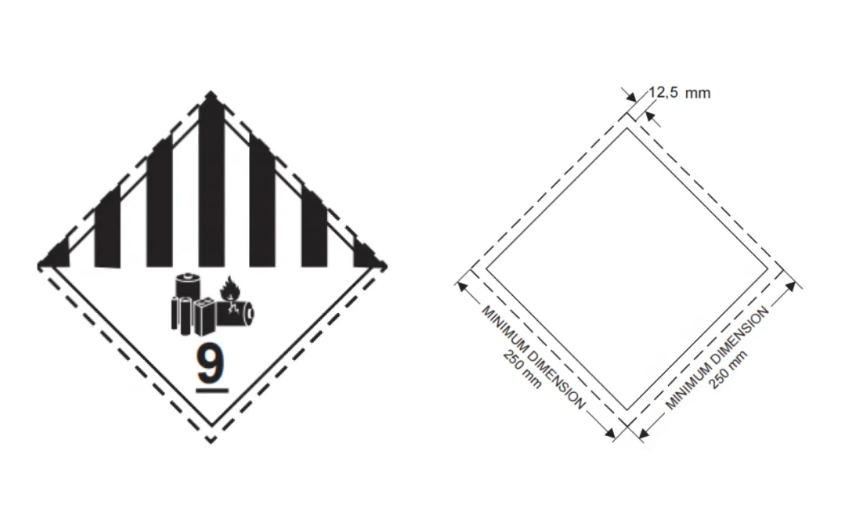
Placards shall be configured in accordance with Figure 5.3.0 of the Model Regulations.
III. Clean‑up of Supporting Provisions and Text Revisions: Synchronous Update of System Documentation
The draft also repeals multiple legacy clauses. Enterprises shall update reference sources when compiling transport appraisal documents and compliance system files:
Legacy Special Provision SP230 is formally deleted and no longer has compliance validity.
Supplementary guidance for SP188: definitions for cells, monolithic‑cell batteries and battery packs shall uniformly refer to section 38.3.2.3 of the Manual of Tests and Criteria.
Revised wording for SP376: references to former SP230 are removed; compliance assessment shall now follow clauses 2.9.4 and 2.9.5 of the Model Regulations.
IV. Industry Impacts of the New Rules
✅ Battery manufacturersAfter implementation of the 50 Wh exemption threshold, high‑capacity monolithic‑cell products are exempt from mandatory dangerous‑goods transport classification. However, product classification criteria are more granular. Bare cells and finished batteries must not be conflated to avoid non‑compliance from mis‑classification.
✅ Logistics and foreign‑trade sectorsStandardised definitions and simplified packaging rules will reduce inspection discrepancies at customs clearance. Nevertheless, tightened mandatory marking and placard requirements create compliance risks for shipments without prior remedial adjustments.
V. Enterprise Self‑Inspection & Remedial Action Checklist
Inventory full product portfolio; classify bare cells, finished monolithic‑cell batteries and battery packs, and calculate rated energy for each item.
Implement production‑line modifications to add permanent rated watt‑hour marking on housings of finished lithium‑ion / sodium‑ion batteries.
Re‑review packaging solutions for standalone‑shipped products; optimise structures while guaranteeing anti‑short‑circuit and anti‑collision protection.
Prepare compliant Class 9A placards for large freight units, complying with specified dimensions and affixing positions.
Pre‑review cited clauses within UN38.3 test reports and goods transport condition appraisal certificates.
Keep track of the official effective date of the regulations and reserve sufficient transition time for end‑to‑end remedial implementation.
Closing ReminderThe above content remains a revised draft. The official effective date will be confirmed upon formal release of the Model Regulations. The policy transition period constitutes a critical window for enterprises to complete compliance remediation.
If you require UN38.3 testing for batteries, goods transport condition appraisal or product compliance risk assessment, our technical team can deliver professional technical support.