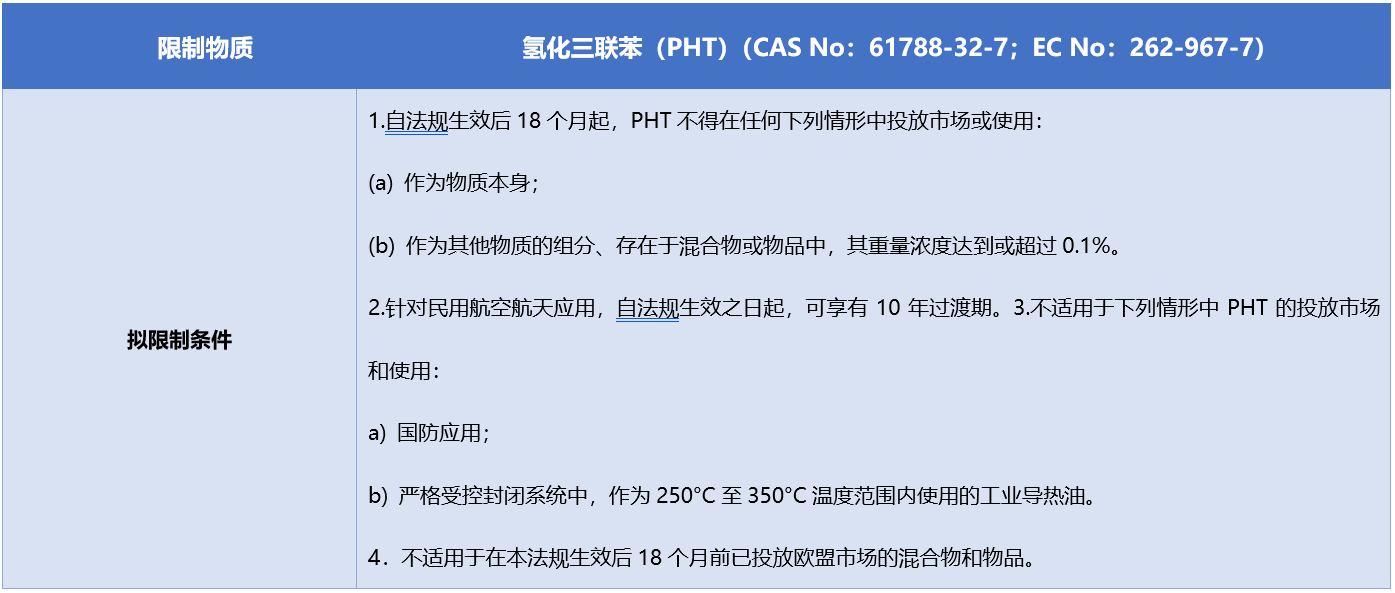
On May 8, 2026, the World Trade Organization (WTO) issued Circular G/TBT/N/EU/1205, and the European Commission formally proposed to amend Annex XVII of REACH Regulation (EC) No.1907/2006, adding restrictions on hydrogenated terphenyls (PHT). The deadline for public comments on the draft circular is July 7, 2026, and it is planned to be formally adopted in the fourth quarter of 2026, and it is planned to take effect on the 20th day after the publication of the official bulletin of the European Union.
The new restrictions are as follows:
About hydrogenated terphenyls (PHT)
Hydrogenated terphenyls (PHT, Terphenyl, hydrogenated, CASNo.: 61788-32-7) is an important organic compound. It has the characteristics of high thermal stability, low vapor pressure and good oxidation resistance, and can be used stably in the high temperature range of 250 C-350 C. It is widely used in chemical industry, plastics, electronics, coatings, heat transfer oil, cables and other industries. According to EU REACH regulations, hydrogenated terphenyl is listed as substances of very high concern (SVHC) because of its high persistence and high bioaccumulation.
Corporate compliance advice
1. Comprehensively check the supply chain: sort out raw materials, additives, semi-finished products and finished products, confirm whether they contain PHT, accurately detect the concentration of PHT, and put an end to illegal products ≥0.1%.
2. Look for alternatives in advance: for heat transfer oil, plastic additives, coating additives and other scenarios, select alternative substances with compliance and performance matching, and complete formula iteration and process adjustment.
3. Control the rhythm of production and inventory: During the buffer period, gradually clear away the inventory of PHT-containing products, optimize the production plan, and ensure that no illegal products leave the factory after the implementation of the new regulations.
4. Retain compliance certificates: archive raw material inspection reports, supply chain traceability records, compliance certificates of substitute substances and other documents, and conduct spot checks on EU customs and market supervision.
Warm tips
Our company has a professional technical team and rich experience in product testing, which can help you easily understand whether the products are safe and compliant. If you need it, please feel free to contact us, and our engineers will serve you at the first time!